Odaiba A Day Out on Tokyo Bay Built for Leisure Not for Staying
Odaiba is Tokyo's reclaimed island playground of malls, museums, and bay views. Here is what is actually there, what has moved, and how to get across the Rainbow Bridge.
- Flag
-

- ISO code
- JP
The Train Rides Over the Water and You Already Forget the Map
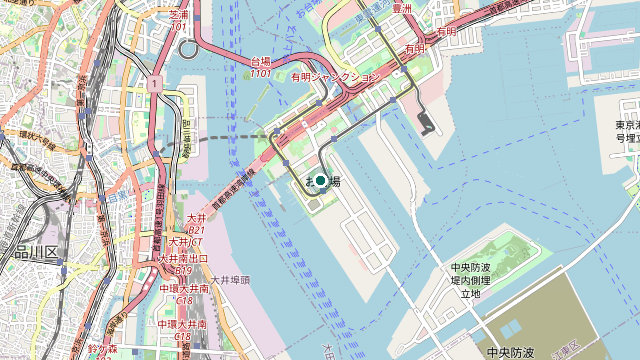
The Yurikamone train lifts off from Shimbashi at 10:15 and banks hard left, and suddenly you are suspended above a highway, then above cargo cranes, then above Tokyo Bay. The cabin tilts. The Rainbow Bridge cables flick past at eye level. Behind the glass, the skyscrapers of Shiodome shrink to matchsticks. This elevated approach is the whole point. Odaiba does not pretend to be a continuation of the city. It is a purpose-built leisure island on reclaimed land, and the transit system itself announces that you have left Tokyo proper.
You step off at Daiba station or Odaiba-Kaihinkoen and the air changes. Wider pavements. Fewer shadows. The streets are laid out on a grid that a child could navigate, and that is intentional. Odaiba was built for staying a day, not for staying overnight. Its hotels are few and feel like afterthoughts. The island exists to absorb families, couples, and anyone who needs a clean, wind-blasted break from the narrow lanes of Kagurazaka or the tunnel chaos of Shinjuku station.

What is Here Now and What is Not
TeamLab Borderless Is Gone
Clarify one thing before you plan. teamLab Borderless does not exist in Odaiba anymore. It reopened on 9 February 2024 at Azabudai Hills in Minato-ku, a 15 minute walk from Kamiyacho station or a taxi from Tokyo Tower. The old venue at Palette Town is gone. That entire complex is under redevelopment, with completion targeted for 2026. The giant Ferris wheel? Gone. VenusFort, the mall with the fake Roman ceiling? Closed 27 March 2022. The onsen Oedo-Onsen Monogatari? Closed 5 September 2021.
The Alternative: TeamLab Planets
The surviving teamLab venue in the area is teamLab Planets, at 6-1-16 Toyosu, a short bus or taxi ride from Odaiba's southern edge. It runs through the end of 2027. Book tickets weeks ahead. You walk through knee-deep water in a darkened room, digital koi swim around your ankles. It is a physically different experience from Borderless: more tactile, less maze-like, and slightly more disorienting. Allow 90 minutes inside.
The Gundam And The Malls
What remains is unapologetically large-scale. DiverCity Tokyo Plaza at 1-1-10 Aomi holds the 19.7-metre Unicorn Gundam statue. It transforms four times during the day and once at night, with a projection show on the building facade. Check the schedule at the information desk when you arrive; the show times vary seasonally. The mall itself is a standard Japanese shopping centre with an Uniqlo, a Pokémon store, and a ramen theme park on the third floor. It is fine. It is not a reason to come here on its own.
Across the footbridge, Decks Tokyo Beach at 1-6-1 Daiba holds a shopping arcade with a Tokyo Shitamachi recreation floor that simulates 1960s street life. It is executed with Japanese precision: fake fruit, fake canals, fake atmosphere. Children enjoy it. Adults may find it creeps past kitsch into something almost odd. Next door, Aqua City Odaiba at 1-7-1 Daiba offers the usual fashion brands and a food court with bay views, and a Starbucks where you can sit and watch the arc of the Rainbow Bridge.
The Walk Across the Rainbow Bridge and the Beach
The Bridge Walk
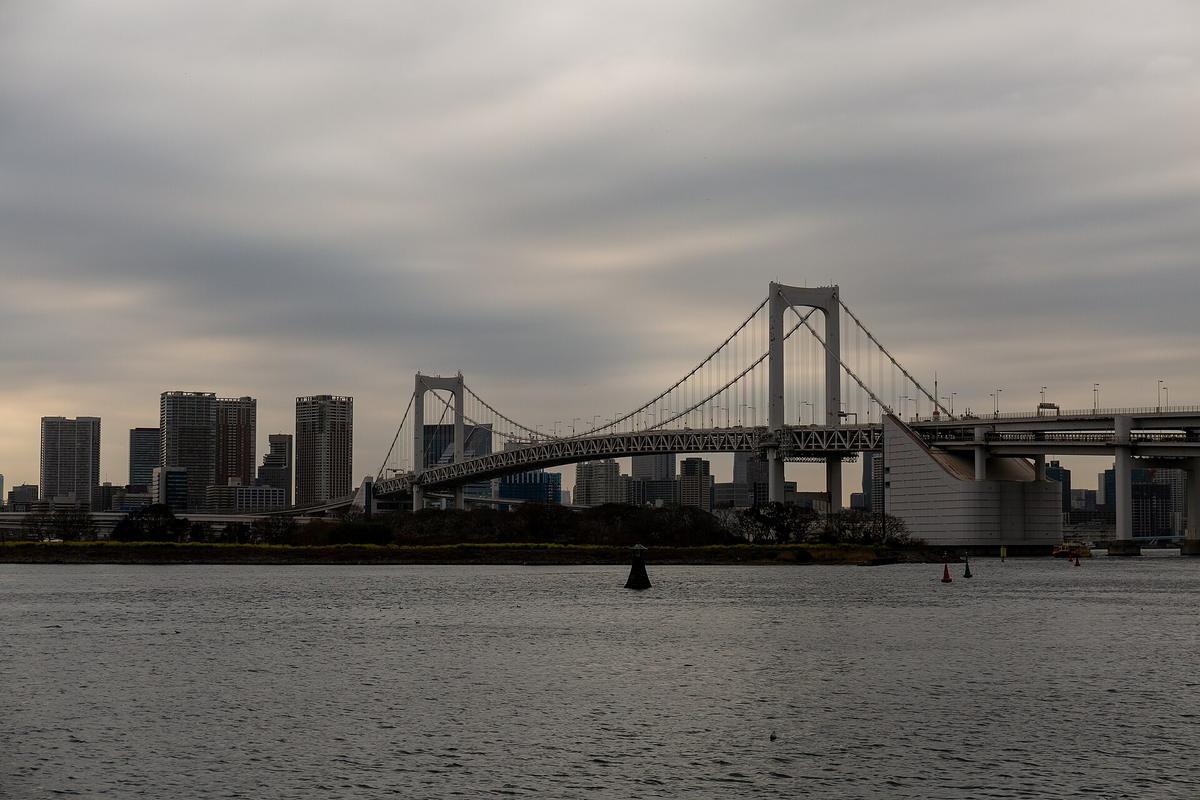
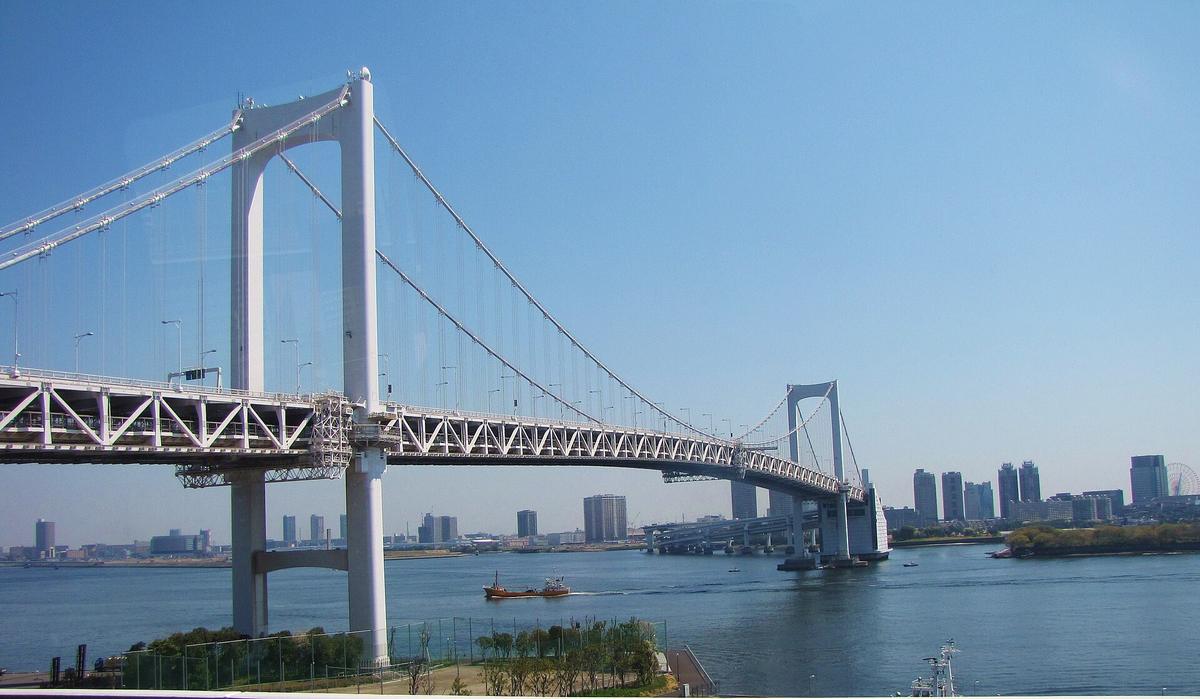
The Rainbow Bridge pedestrian walkway is free and open 09:00 to 21:00 April through October, and 10:00 to 18:00 November through March. Enter from the south side near Odaiba Marine Park. The north route runs 1.7 kilometres to the Shibaura side. It takes 35 minutes at a steady pace. The chain-link fencing is high enough that you cannot photograph cleanly, but the view is unobstructed directly east toward the bay. Do this at 16:00 in autumn. The light goes soft over the water, and the freight ships drifting past Yumenoshima island look like cut-outs. The bridge closes at 18:00 in winter, so start by 16:30.
The Beach
Odaiba Marine Park runs about 800 metres along the waterfront. It is a man-made beach with coarse sand and an artificial reef. You cannot swim. But families sit on towels in June, and couples lean on the railings at dusk. The real use is as a promenade. Walk from Aqua City to the Telecom Center past the Statue of Liberty copy, a gift from France. It is smaller than the original. It is also free.
The Museum Worth the Entry and What to Skip
Miraikan: The One You Do
Miraikan, the National Museum of Emerging Science and Innovation at 2-3-6 Aomi, is the single attraction on Odaiba that justifies a trip from central Tokyo on its own. Admission costs ¥630 for adults, ¥210 for children 6 to 18. Hours are 10:00 to 17:00 with last entry at 16:30. Closed Tuesdays. The main draw was the ASIMO demonstration, but ASIMO stopped public appearances in 2018. The current attraction is the Geo-Cosmos, a 6.5-metre suspended globe that displays real-time climate data. The exhibits on deep-sea submersibles and the International Space Station module are bilingual and tactile. You can spend two hours here without boredom. Arrive at 10:00, head to the third-floor planetarium first, book the English-language show at the ticket counter, then work down.
What to Skip
Skip the Tokyo Joypolis indoor amusement park unless you have a teenager who insists. The rides are old, the queues in Japanese only, and the air inside smells of carpet cleaner and regret. The KidZania franchise in the same building is better but requires a half-day commitment and a child under 14. Adults without children have no reason to enter.

Getting There and Moving Around
Two Rail Lines
You have two rail options. The Yurikamome Line runs from Shimbashi, costs ¥520 for a single ride to Odaiba-Kaihinkoen, or ¥820 for a one-day pass that covers unlimited hops between all seven Odaiba stations: Odaiba-Kaihinkoen, Daiba, Tokyo International Cruise Terminal, Telecom Center, Aomi, Ariake, and Toyosu. Buy the one-day pass if you plan to visit Miraikan plus a mall plus the Gundam. Otherwise, pay as you go. The train runs every four to six minutes.
The Rinkai Line connects directly to Shinjuku and Shibuya in about 25 minutes from Tokyo Teleport station. This is faster if you are coming from the west side of the city. The Rinkai is a commuter line, so it feels less like an attraction and more like a train. Use it for the return journey when the novelty of the bay view has worn off. The Yurikamome is the scenic route. The Rinkai is the efficient one.
Moving Around the Island
One practical note: the mall corridors between stations are longer than they appear on a map. A walk from Daiba station to Miraikan takes 12 minutes above ground but 20 through the underground passages. The passages are climate-controlled. Use them in August, when the humidity hits and the 800-metre beach offers no shade at all.
Is Odaiba Worth a Full Day Trip and How Do You Reach it from Central Tokyo
Is teamLab Borderless still in Odaiba?
No. teamLab Borderless moved to Azabudai Hills in Minato-ku and reopened there on 9 February 2024. The Odaiba venue is closed permanently.
What is the best way to get to Odaiba from Shinjuku?
Take the Rinkai Line from Shinjuku station to Tokyo Teleport. The trip takes about 25 minutes. You do not need to transfer.
How much time should I budget for Odaiba?
A half day is enough for one attraction plus a meal. A full day works if you combine Miraikan, the Gundam statue, a mall lunch, and the Rainbow Bridge walk.
Can I swim at Odaiba Marine Park?
No. The beach is for walking and sitting. Swimming is prohibited. The water is not clean enough, and the currents near the bridge are dangerous.
What is the best time of year to visit Odaiba?
October and November offer mild temperatures and clear skies. The bridge closes at 18:00 in winter, so start your walk by 16:30. Avoid mid-August when humidity makes the exposed promenade miserable.
Read next
-
 Japan Travel Guide for First-Timers Who Like Order but Not Crowds
Japan delivers deep tradition and futuristic efficiency, but the language barrier and density of rules can exhaust first-timers. Here is what to actually expect.
Japan Travel Guide for First-Timers Who Like Order but Not Crowds
Japan delivers deep tradition and futuristic efficiency, but the language barrier and density of rules can exhaust first-timers. Here is what to actually expect.
-
 Japan eSIM vs Pocket WiFi vs Physical SIM for Staying Connected
Free public WiFi across Japan is unreliable and slow. What separates eSIM plans is which Japanese carrier they ride on, and whether hotspot sharing is allowed.
Japan eSIM vs Pocket WiFi vs Physical SIM for Staying Connected
Free public WiFi across Japan is unreliable and slow. What separates eSIM plans is which Japanese carrier they ride on, and whether hotspot sharing is allowed.
-
 Japan Visa-Free Entry and the Visit Japan Web Digital Form
Visa-free entry covers many nationalities, but the Visit Japan Web digital form and QR codes determine how quickly you clear immigration at Narita or Haneda.
Japan Visa-Free Entry and the Visit Japan Web Digital Form
Visa-free entry covers many nationalities, but the Visit Japan Web digital form and QR codes determine how quickly you clear immigration at Narita or Haneda.
-
 Cash and IC Cards Are the Real Payment System in Japan
Japan projects a high-tech image but many small restaurants, temples, and rural buses demand cash. IC cards like Suica and Icoca bridge the gap for daily spending.
Cash and IC Cards Are the Real Payment System in Japan
Japan projects a high-tech image but many small restaurants, temples, and rural buses demand cash. IC cards like Suica and Icoca bridge the gap for daily spending.
-
 Fifth Freedom Flights Are the Award Sweet Spot Nobody Searches For
Fifth-freedom flights let you fly a foreign airline between two other countries, and they often have award seats when the airline's own hub routes are sold out.
Fifth Freedom Flights Are the Award Sweet Spot Nobody Searches For
Fifth-freedom flights let you fly a foreign airline between two other countries, and they often have award seats when the airline's own hub routes are sold out.
-
 Every Way Into an Airport Lounge and What Each One Actually Costs You
-
 When a Mileage Upgrade Is the Wrong Way to Spend Miles
Upgrading a paid ticket with miles sounds efficient but the required fare class often costs so much that a straight award booking in the same cabin is cheaper.
When a Mileage Upgrade Is the Wrong Way to Spend Miles
Upgrading a paid ticket with miles sounds efficient but the required fare class often costs so much that a straight award booking in the same cabin is cheaper.
-
 Mistake Fares and Whether an Airline Actually Has to Honour Your Ticket
Mistake fares generate excitement but most airlines cancel them and refund your money, and the US DOT rarely forces them to honour the ticket.
Mistake Fares and Whether an Airline Actually Has to Honour Your Ticket
Mistake fares generate excitement but most airlines cancel them and refund your money, and the US DOT rarely forces them to honour the ticket.